‘Hey, at least he was a Satanist, not an Atheist.’

In 1992 the Fantoft Stavkirk in the borough of Fana in Bergen, Norway burned to the ground.  Originally erected in the mid-12th century in Eastern Sognefjord, and then transported in the 19th century to its present location, it was the first in a string of church burnings to take place in the early 1990s.

A stavkirk, or ‘stave church,’ gets its name from a type of medieval construction that consists of a timber-framed post and lintel design.  Once found throughout northern Europe, the majority of those still in existence are only found in Norway.  The term ‘stav’ refers to the load-bearing posts that hold the structure in place.

Though rebuilt, the Fantoft Stavekirk still shows signs of its destruction, particularly the chain link fence that surrounds the structure and the warning signs about alarm systems and closed-circuit recordings.

In 1994 Varg Vikernes (born Kristian Vikernes) was convicted for burning, or attempting to burn, the Åsane and Storetveit Churches in Bergen, the Skjold Church in Vindafjord, and the Holmenkollen Chapel in Oslo.  He was also sentenced for the murder of Øystein ‘Euronymous’ Aarseth.  burzum_aske_burning__Fantoft_Stave_ChurchHe was found not guilty of burning the Fantoft Stave Church, but has been connected to the arson both for his support of the act, as well as for the image of the burnt structure used as the cover of his album, ‘Aske’ (‘ashes’ in Norwegian).

Accusations of Satanism as the reason for these burnings have been generally established.  This derives heavily from the type of ‘Theistic Satanism’ espoused by the members of the early Norwegian black metal scene, such as that promoted by bands such as ‘Mayhem,’ ‘Emperor,’ ‘Thorns,’ and Vikernes’ ‘Burzum.’  Also known as the ‘Black Circle,’ this group of individuals established an ideological discourse of misanthropy, an inverse Christianity that focused more on promoting ‘evil,’ rather than on any sort of Satanic philosophy.

Admittedly, this discourse is not something I know all that much about.  In fact, for anyone interested in this topic, I would highly recommend these sources:

  • The work of Asbjørn Dyrendal in the Department of Philosophy and Religious Studies at the Norwegian University of Science and Technology in Trondheim.
  • The doctoral work of Cimminnee Holt at Concordia University, Montreal.
  • Michael Moynihan’s book on the subject, The Lords of Chaos.
  • The work of Jesper Aagaard Petersen in the Programme for Teacher Education at the Norwegian University of Science and Technology in Trondheim.
  • The work of Titus Hjelm at the University College London’s School of Slavonic and East European Studies.
  • The 2008 film ‘Until the Light Takes Us,’ which chronicles the black metal movement’s ideologies. 

As well, it is not the focus of this post.  Rather, my interests herein have to do with a comment made in passing with a friend about the Stave Church and the fact that it was burned by a ‘Satanist.’  When discussing the burning and the black metal scene in Norway, this individual, knowing I research Atheist discourses, and perhaps feeling it might be interpreted as a compliment to Atheism, stated: ‘Hey, at least he was a Satanist, not an Atheist.’

While there is much to be said about the accuracy of this casual assurance, regardless of the intricate discursive details that could support or refute its simple categorisation, it reminded me of a theory I put forth a few years ago in a paper presented in a seminar at Baylor University in Waco, Texas.

As occurred on occasion during this time, and a bit over the years since, I have found myself unwittingly defending Atheism against accusations of seemingly bizarre connections.  One of these, which does not happen often, but still with enough occurrence that it warrants a bit of a chuckle, is the idea that Atheists believe in/worship/support Satan/Satanism.  In their defence, these individuals’ ideas are likely the result of discursively combining what they deem as ‘evil’ into a singular abstraction.  For them, Atheists have denied God, and are thus evil, just as Satanists have taken up with God’s opposite, and are thus equally evil.  Regardless of the fact that an individual who denies the existence of God might still believe that God’s opposite might then still exist is a bit logically absurd, this sort of thinking is more about categorising an individual as an opposite of oneself, rather than constructing any sort of accurate description.

This got me thinking, partly because I was asked to be the contrarian in the room for these seminars, the voice of opposition or devil’s advocate that might inspire more passionate discussion.  Is there a connection between Satanism and Atheism, beyond the shared similarity of ‘evilness’ in the eyes of certain individuals?  That is, is there a connection beyond this sort of generalised stereotype?  So, I looked at two origins of each term: the first derived from a particular means of defining a particular discursive example of Atheism, and the second from the context of its usage in both the Hebrew and Christian Bibles.

Atheism

As I’ve written about previously, the concept ‘Atheism’ is one that is not easily determined, regardless of the fact that we might perceive it as such due to the inherent nature of it being the ‘belief (or absence of belief) in the existence of God.’  In fact, the history of its definition is one of abstraction and creativity, demarcated by historical representations and theoretical stipulations.  What this equates to is a discourse that is not altogether cohesive.  Which is neither a bad thing, nor is it in any way detrimental.  That is, of course, as long as we are not set on defining the term in a manner that might be representative of any and all types, uses, and iterations.  If this is our goal, then this becomes quite an issue.  Which might explain why we have so many additions to the latter, theoretical, category.

Instead, if we focus our attention on the historical definitions, that is, the definitions of the term based on real people in real places and at real times, either called ‘Atheist’ or who identify as such, then we turn toward discursive interpretations.  These are ‘definitions’ that are neither ‘right’ nor ‘wrong.’  Instead, they simply exist as examples, as contributions to a larger discourse about what we mean when we talk about Atheism.

Within this category we find examples of what has been demarcated as ‘ancient Atheism,’ labeled as such in regard to the way it differs from ‘modern Atheism.’  While this is a discussion that will likely re-occur throughout this particular discourse on the subject, to summarise, this differentiation is made by two specific actions: imputation and self-description.  In cases of the former, Atheism is a term used to describe an other, particularly an other who, through his beliefs and arguments, has acted against the status quo of the state.  These individuals are deemed ἄθεος.  In etymological terms, they are ‘without god.’  Now, this takes on a number of different types of ‘absence,’ from Socrates’ corruption charge for turning the youth of Athens away from worshipping certain gods, to Milesian philosophers like Prodicus of Keos who used philosophical logic to argue that the gods were in fact, as Euripides’ Sisyphus also argues, created by man to make sense of one’s day-to-day needs.

One of the underlying themes of this ‘ancient Atheism’ is a sense of doubt.  This doubt, likewise based on the individual expressing it, fluctuates from mere hesitation in believing something outright, to more direct rejection or disbelief.  We see this evinced by philosophical arguments that we might, from a modern perspective, deem ‘Atheistic.’  For example, consider Anaxagoras’ argument that the sun, heliosrather than the god Helios moving across the sky, is in fact just a molten ball of iron.  Or the naturalistic arguments of Thales, Anaximander, and Anaximenes who defended the idea that nature and the natural world could be understood without an allegiance to mythology.  These are unique types of doubt, reflective of individuals who questioned the prevailing or popular beliefs of their time.
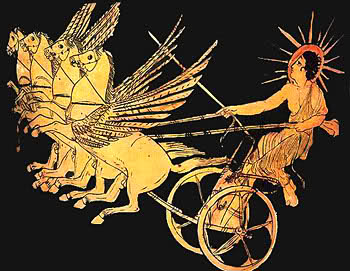
As discursive examples of ἄθεος these illustrations of doubt lead us to the notion that Satan, as a concept itself, embodies a particular type of Atheism.

Satan

In its Biblical manifestations the notion of ‘Satan’ is, in many ways, as difficult to clarify as Atheism.  For summary purposes here, we might distinguish different discursive examples, designed and determined by the way the term is used.  This, we might even further resolve, is divisible between ‘Satan-as-concept’ and ‘Satan-as-character.’

Beginning with Numbers 22:32, the term ‘Satan’ (שָׂטָן) meant ‘opponent’ or ‘adversary:

The angel of the Lord asked him, ‘Why have you beaten your donkey these three times?  I have come here to oppose you because your path is a reckless one before me.

This continues in 1 Samuel 29:4, in reference to David amongst the Philistines:

But the Philistine commanders were angry with him and said, ‘Send the man back, that he may return to the place you assigned him.  He must not go with us into battle, or he will turn against us (opponent, שָׂטָן) during the fighting.

Again, this notion of ‘Satan’ as ‘adversary is repeated in 2 Samuel 19:35 (“This day you have become my adversaries!”); 1 Kings 5:4 (“But now the Lord my God has given me rest on every side, and there is no adversary or disaster.”); 1 Kings 11:15 (“Then the Lord raised up against Solomon an adversary”); and 1 Kings 11:23 and 11:25.

While these examples represent an adversarial or oppositional position, in the Book of Job, the term is not only embodied by an individual (Satan-as-character), it is also imbued with the overall sense of doubt that becomes commonplace with the concept itself.  In this manifestation שָׂטָן becomes a necessary entity for God, a position of Devil’s advocate, without whom God would not be able to prove the fealty of His creation.

One day the angels came to present themselves before the Lord, and Satan also came with them.  The Lord said to Satan, ‘Where have you come from?’

Satan answered the Lord, ‘From roaming throughout the earth, going back and forth on it.’

Then the Lord said to Satan, ‘Have you considered my servant Job? There is no one on earth like him; he is blameless and upright, a man who fears God and shuns evil.’

‘Does Job fear God for nothing?’ Satan replied.  ‘Have you not put a hedge around him and his household and everything he has? You have blessed the work of his hands, so that his flocks and herds are spread throughout the land.  But now stretch out your hand and strike everything he has, and he will surely curse you to your face.’

The Lord said to Satan, ‘Very well, then, everything he has is in your power, but on the man himself do not lay a finger.’

Then Satan went out from the presence of the Lord. (Job 1:6-12)

Once again, ‘Satan,’ though embodied as an angel (son of God) presenting himself before God, is the representation of an adversary, an individual who, when presented with certain facts, responds with doubtful criticism.  This occurs, almost in an exact manner, in Job’s second test:

On another day the angels came to present themselves before the Lord, and Satan also came with them to present himself before him.  And the Lord said to Satan, ‘Where have you come from?’

Satan answered the Lord, ‘From roaming throughout the earth, going back and forth on it.’

Then the Lord said to Satan, ‘Have you considered my servant Job? There is no one on earth like him; he is blameless and upright, a man who fears God and shuns evil. And he still maintains his integrity, though you incited me against him to ruin him without any reason.’

‘Skin for skin!’  Satan replied.  ‘A man will give all he has for his own life.  But now stretch out your hand and strike his flesh and bones, and he will surely curse you to your face.’

The Lord said to Satan, ‘Very well, then, he is in your hands; but you must spare his life.’

So Satan went out from the presence of the Lord and afflicted Job with painful sores from the soles of his feet to the crown of his head. (Job 2: 1-7)

In the Gospel narratives, this doubtful characteristic becomes something more personal and direct, a character (known here also as ‘Devil’ or ‘διὰβολος’) who exists in order to once again present a pragmatic challenge, the resolution of which assists in directing the narrative itself toward a certain conclusion.

In Matthew 4:1-11, Mark 1:12-13, and Luke 4:1-13 Satan (σατανᾶ) directly tempts Jesus in the desert, a necessary evil in order to further determine Jesus as the Christ, an act of identity formation wherein a certain individual is defined by his interaction with an opposition.

Later, this same sort of oppositional necessity is depicted by Luke 22:3 and John 13:27 in the act of Satan ‘entering’ Judas, thus causing his betrayal.  In this way, Satan acts as a conceptual entity, the notion of Judas here enacting a necessary deed in order to fulfil the prophecy of Christ as a sacrificial lamb.  Though this appears as the ‘work of Satan,’ we might also see it as the work of doubt or opposition.

As a narrative device, the notion of ‘Satan,’ a title that functions as a pun, creates a dichotomous relationship between certain characters.  Almost mimetic of metaphorical or allegorical character development within a milieu prepared and designed for such formational interactions, the idea of Satan is one of narrative utility.

Conclusion

In combining the lexical process of being deemed an ἄθεος (scepticism, doubt, critical debate) with the doubt, opposition, and adversarial nature of Satan (שָׂטָן; διὰβολος) we might confortably conclude here that Satan is, in fact, a representative sort of Atheism.  Which brings us back to the Fantoft Stave Church, its demise at the hands of ‘Satanists,’ and my friend’s assurance that ‘at least he was a Satanist, not an Atheist.’  In this sense, my friend was in fact incorrect.  Etymologically speaking, or even conceptually speaking, Satan is an Atheistic character, designed for the sole purpose of driving along the narrative toward a particular conclusion.  Satan is, in this manifestation, not only an Atheist, but a necessity as well.

My theory, then, might be summarised as such: as a discursive concept, and when interpreted from within the context in which it was established, the notion of ‘Satan’ shares enough of the characteristics that we might find in certain discursive manifestations of Atheism.  In this way, Satan was an early Atheist.  Does this make any sort of modern Satanist an Atheist?  No.  After all, discourses are plastic things, and they change and alter over time.  Just as ‘Atheist’ has come to mean a number of different things to a number of different people over the millennia, Satan has as well.  Of course, I might argue on the side of the illogically absurd notion that since these two concepts, when isolated within the borders of certain Western monotheistic milieux, originated from similar sources, and are thus inextricably linked to a distinct genesis.  Then again, that might just be me playing devil’s advocate again.

Sources

Jan M. Bremmer, “Atheism in Antiquity” in Michael Martin, ed. The Cambridge Companion to Atheism (Cambridge: Cambridge University Press, 2009).

Michael J. Buckley, “Introduction” in Michael J. Buckley, At the Origins of Modern Atheism (New Haven: Yale University Press, 1990).

A.B. Drachmann, Atheism in Pagan Antiquity (Chicago: Ares Publishing, 1922).

David Ferguson, “Atheism in Historical Perspective,” in David Ferguson, Faith and Its Critics (Oxford: Oxford University Press, 2009).

Donald E. Hartley, ‘HEB 11:6—A Reassessment of the Translation ‘God Exists’ (Trinity Journal, 27, 2, 2006).

Charles H. Kahn, “Greek Religion and Philosophy in the Sisyphus Fragment” (Phronesis. Vol. 42, No. 3, 1997).

John Navone, “Satan Returns,” (The Furrow, Vol. 26, No. 9, 1975).

Elaine Pagels, “The Social History of Satan, the “Intimate Enemy”: A Preliminary Sketch,” (The Harvard Theological Review, Vol.84, No. 2 Apr., 1991).

Elaine Pagels, The Origin of Satan (New York: Vintage Books, 1996).

J.P. Reid and B. Mondin, eds., “Atheism” in The New Catholic Encyclopedia (Washington D.C.: The Catholic University of America, 2003).

T.J. Wray and Gregory Mobley, The Birth of Satan: Tracing the Devil’s Biblical Roots (New York: Palgrave Macmillan, 2005)

The Bible: The New International Version.
Assholes: A Theory of New Atheism

Is New Atheism New?

This week we begin a new semester of tutoring, and for the third time I have the privilege to tutor on a course at New College called ‘Atheism in Debate: Dawkins and his Allies.’  While the last two versions of this course have found progressive successes, not only in bringing in students, but also in how the content is presented, there have been, as might be expected, a few complaints.[1]  However, overall it would seem a marginal success.

Of all the discussion points that resurface each year, one has perhaps been brought up more often than any others: the question of comparison.  How, we are often asked, are the New Atheists similar to the ‘old’ ones?  Or, said otherwise, how is New Atheism in any way ‘new?’ These are indeed precarious questions.  After all, when we look at the larger discourse that feeds into the definition of Atheism, we might argue that, in fact, New Atheism is not all that new.  Rather, and as our course tends to conclude, New Atheism is merely the repetition of many of the facets of ‘old’ Atheism.

For instance, one might consider the philosophical positions of those who contribute to the discourse that forms this ‘old’ Atheism, such as Voltaire, Hume, Strauss, Marx, Feuerbach, Hegel, or Nietzsche, in comparison to the critiques made by the New Atheists.  Many of these same thoughts are, presumably, ‘recycled.’

However, I might offer a discursive defence of New Atheism here.  Yes, we might see similarities between these two Atheisms, or even almost identical critiques in Harris’ The End of Faith or Dawkins’ The God Delusion.  Yet, I would argue this sort of criticism overlooks the much larger distinction of contextualization, so that, even though the criticisms made by these ‘New Atheists’ seem like recycled arguments from the ‘old Atheists,’ they are still being made in completely different contextual milieux.  The time in which Strauss was writing his Life of Jesus, or Voltaire his Candide is not the same as the context that birthed Dennett’s Breaking the Spell or Hitchens’ God is not Great.  That is, while I would agree that through comparison we might not find anything inherently ‘new’ about New Atheism, I would also concede that it arose out of an entirely different time and place, and thus offers us, if nothing else, an insight into that context so that we might locate why and how these particular critiques took shape.

In this way, the New Atheism is a discursive product.  The language used is that of particular individuals in a particular time, and in particular places.  For me, then, trying to compare or contrast the ‘old’ and the ‘new’ fundamentally overlooks the fact that comparisons are not necessary, and, what’s worse, can become abstractions, distracting us from finding value in each of these ‘types’ of Atheism as discursive or cultural data. Yet, New Atheism as a title still persists.  Is that a wholly negative issue?  Yes and no.  On one end, giving even a nominal distinction to this discursive sample engenders a dichotomous perspective, demanding a comparison, and leading us back to those same abstractions where we might find ourselves lost amongst an apologetical argument that one is more ‘genuine’ or ‘original’ than the other.  On the other end, we have the issue of too slack a distinction.

In this way, we might find ourselves, such as occurs in the larger discussion of the definitions of Atheism or ‘religion,’ with having to contend with the differentiation between ‘nominal’ and ‘virtual’ terminology: the former denoting a word that can be used in any number of iterations, and the latter denoting a use of that word in a more unique or specific way (see Jenkins 2008).  This also brings us into discussions about the differences between real or essential definitions (terms that act to summarise the ‘essence’ of a thing) and lexical or historical ones (terms that have particular meaning to particular individuals at particular times [see Baird 1991]). While these are worthwhile discussions, and are quite pertinent to the issue at hand, this is neither the time nor place to truly devote our attention to such issues.  Rather, I will from here on adopt a perspective that might be deemed more on the side of the virtual or lexical, and try to make some sense out of the persistent question concerning the ‘newness’ of New Atheism within the context of it as a discursive source.

Assholes: A Theory

The erudite and somewhat famous theorist of religion, Ninian Smart, was said to have a method of teaching that perfectly exemplified his notion of epoche.  A practice employed by researchers and lecturers, ‘epoche’ essentially means the suspension of one’s disbelief, a pragmatic mindset utilised in order to remove the individual from either interpreting or Ninian_Smartpresenting the concept religion with any sort of confessional bias.  For Smart, this did not mean the complete abandonment of one’s personal beliefs, but rather was a means with which the researcher/lecturer might objectively approach a subject like religion without muddling the data with subjective opinions.

After all, we might remark, studying something is not the same as advocating it, just as studying that same thing is not the same as being without an opinion about it.  It’s a fine line, indeed, but in the pursuit of objectivity it’s always useful to recognise and acknowledge the utility of these sorts of distinctions.

As the stories go, Smart would stand on one side of the lectern (let’s say the right) when lecturing, giving ‘just the facts.’  When asked, or when he felt inclined to do so, he would switch to the other side (the left) and give his opinion.  This bipolarity would, one might imagine, be quite entertaining, especially when dealing with religious beliefs and practices that might seem ‘taboo’ or ‘provocative’ to a particular audience. For my intentions herein, this little anecdote is quite useful.  While I (on the right side) approach Atheism as a discursive term, something that is imbued with meaning through the use of particular language by particular people in particular times and places, and thus approach it with a strict objectivity, that doesn’t mean that on the left side I do not have an opinion of my own.  However, I also might acknowledge that a strict binary between these sides is not always the most useful.  Thus, the following theoretical approach might be best understood as a sort of ‘tacking,’ a ‘back-and-forth’ approach that demonstrates both a right and left side perspective.

For me, what makes New Atheism new is that the New Atheists are assholes.

In his, Assholes: A Theory, the political philosopher Aaron James defines an asshole as someone not only immune to his or her own criticisms, but who, when criticised with the same sort of language, feels that he or she is, in fact, an unprovoked victim.  assholesIn summary, his brief definition states:

Our theory is simply this: a person counts as an asshole when, and only when, he systematically allows himself to enjoy special advantages in interpersonal relations out of an entrenched sense of entitlement that immunises him against the complaints of other people. (4-5)

More focused on a few ‘stereotypical’ examples, such as demonstrated by individuals like US General Stanley McChrystal, US General Douglas MacArthur, Silvio Berlusconi, Hugo Chavez, Mahmoud Ahmadinejad, Donald Trump, Simon Cowell, Mel Gibson, and Ann Coulter, an asshole is someone who, like these individuals, believes their opinion to not only be correct, but infallible via a sense of privilege.  In three parts, this is as follows:

(1)   allows himself to enjoy special advantages and does so systematically;

(2)   does this out of an entrenched sense of entitlement; and

(3)   is immunised by his sense of entitlement against the complaints of other people. (5)

To further define this individual, and in order to lead me toward my association of New Atheism and James’ theory itself, he offers a few more examples:

So, for example, the asshole is the person who habitually cuts in line.  Or who frequently interrupts in a conversation.  Or who weaves in and out of lanes in traffic.  Or who persistently emphasises another person’s faults.  Or who is extremely sensitive to perceived slights while being oblivious to his crustiness with others. (5)

Now, to differentiate the asshole from, say, a ‘jerk,’ the former is defined by inclinations or incentives:

What distinguishes the asshole is the way he acts, the reasons that motivate him to act in an abusive and arrogant way.  the asshole acts out a firm sense that he is special, that the normal rules of conduct do not apply to him. (5-6)

Thus, because the asshole is immune to his or her own criticism, and because he or she sees him or herself as unique or different or special, he or she equally becomes incensed by the beliefs or opinions of others:

Because the asshole sets himself apart from others, he feels entirely comfortable flouting accepted social conventions, almost as a way of life.  Most important, he lives this way more or less out in the open.  He stands unmoved when people indignantly glare or complain.  He is ‘immunised’ against anyone who speaks up, being quite confident that he has little need to respond to questions about whether the advantages he allows himself are acceptable and fair.  Indeed, he will often himself feel indignant when questions about his conduct are raised. (6)

New Atheism and Assholes:

New Atheists are assholes because their language (discourse) is imbued with the sort of criticism James associates with the definition above.  They are overly critical of a particular position, and yet they feel as if they are immune to counter criticism because their position is incapable of being incorrect.

This is partly shaped by the style of their arguments, the way they seem, with such ease and skill, to set up straw man positions, only to easily knock them down.  Look at Harris’ opening characterisation in The End of Faith.  The-End-of-Faith-283644After giving a short description of a young man who has detonated himself on a full public bus, he casually, with almost Dan Brown efficiency, refers to these as ‘the facts:’

These are the facts. This is all we know for certain about the young man. Is there anything else that we can infer about him on the basis of his behavior? Was he popular in school? Was he rich or was he poor? Was he of low or high intelligence? His actions leave no clue at all. Did he have a college education? Did he have a bright future as a mechanical engineer? His behavior is simply mute on questions of this sort, and hundreds like them. Why is it so easy, then, so trivially easy—you-could-almost-bet-your-life-on- it easy—to guess the young man’s religion? (11)

In a note at the end of this characterisation, he offers a description and some details about a Sri Lankan separatist movement known as the Liberations Tigers of Tamil Eelam.  However, this does not mean that the description of the young man on the bus is in any way based in fact.  We might ask, why?  Why not just provide a detailed and cited description?  Why make something up?

As an introductory statement about his treatment of ‘religion’ this fictionalisation perhaps best describes his asshole nature.  Rather than engage with these sorts of atrocities in a manner that might be conducive to a rational or objective criticism, he instead creates a violent example that he then uses to demonstrate his larger criticism of religion as inherently violent.  As he blithely states with the cited paragraph above, associating this sort of action with religion is a trivial connection, so easy, in fact, you could bet your life on it.

While each of the four New Atheists (which I would argue wholly embody the concept ‘New Atheism)’ use this same sort of argument in their own ways, they are not equal in their assholeness.  In fact, Dennett, whose career as a philosopher has distinguished him as a rather erudite examiner of cognition and scientific philosophy seems somewhat out-of-place in this discourse.  Aside from the fact that his argument in Breaking the Spell breaking the spellthat religion could, and should, be scientifically examined, might be roughly dismissed if someone merely walked him across his campus to the Religious Studies department, the language he uses is not altogether that of an asshole.  On the other hand, Dawkins is perhaps the larger asshole of the group.  god is not greatThough Hitchens comes in a close second, Dawkins’ vocal and vehement language, as well as his seemingly evangelical passion, easily characterises his asshole nature.  god delusionIn fact, as perhaps the predominant voice in shaping the New Atheist discourse, his being an asshole is what really shapes this discourse in this way.

There are a myriad of examples to cite here.  Perhaps too many.  Here are just a few.

One of the possible reasons Dawkins seems like such an asshole is the fact that in his obsession with arguing the inherent violence and uselessness of religion, he is betraying the objectivity of his position as a biologist.  One might even ask why a biologist would be in any way interested in religion, which is all too obvious given his extremely poor, almost amateur level of criticism in The God Delusion.  What’s interesting here, though, is that his need to point out the problems of religion seems to overpower his notion that there is, in fact, grandeur to be found in his scientific worldview.  Look at the opening discussion in the trailer of his and Lawrence Krauss’ The Unbelievers:

When asked which is more important, teaching the beauty and majesty of science, or ‘destroying religion,’ his hesitation, and then later acceptance toward the latter, is quite telling.  First off, why would anyone assume that he might actually be able to do so, even with the power of scientific discovery on his side?  Second, rather than promoting something that he finds more useful or beneficial than religion, he would prefer the latter, to point out the negative aspects instead.  A clear ‘asshole move.’

Interestingly, his asshole nature is even utilised by others.  For example, in the first year of our course on Atheism in Debate, one of our guest lecturers played the following video clip, not just because it provides a useful sample of the sort of ‘asshole Atheism’ that Dawkins himself seems to promote, but because it equally demonstrates how his Atheism is used by others to facilitate debate.

The part of this clip discussed in that lecture begins around the 2:40 mark.  Dawkins has joined the circle ‘on stage’ and immediately begins his all too expected attack on religion, particularly aimed at mormonism, embodied by another guest, Brandon Flowers (the lead singer of The Killers).  Note the way he describes the Book of Mormon as a ‘modern fake,’ the product of a charlatan or crook, the way he vehemently attacks his opponent with no real provocation.

This not only demonstrates Dawkins’ asshole nature, it also exhibits the way he represents a discursive entity.  Judging by the way this conversation goes, by the way it is directed by the host, by what Dawkins says, and the fact the Brandon is given really no time to defend himself, this clip provides for us an insight into how others view and use particular discourses to their benefit.  As the signature asshole Atheist, Dawkins has become a useful example.  He is placed across an adherent to a religious belief system that he would, presumably, disagree with, and is then prompted to respond about Mormonism as if the person across from him stands as an equal representative of his objections.  One could even hypothesise that prior to his joining the group ‘on stage’ he was prepared ‘backstage’ with points about the discussion, yet not told, perhaps pragmatically, that his opponent in this debate would be whisked away without given the chance to respond.  In fact, around the 4:46 and 5:00 minute mark it looks almost as if Dawkins is embarrassed by his actions, even apologising to Brandon, as if he was unaware that he would be leaving without the chance to defend himself.

This gives us a glimpse at the asshole realising he has been an asshole, and then regretting, even briefly, his asshole nature.

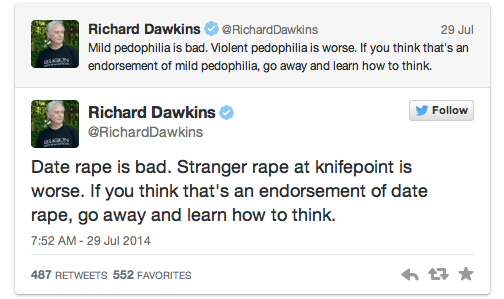
As a last example, we might look at his ever-entertaining comments on twitter, two of which should suffice for this analysis.  The first, focused on his opinion about aborting a child discovered to have Down Syndrome, presents the sort of language inherent in James’ definitions above.

Screen Shot 2015-01-20 at 22.22.26

While the opening line is a somewhat benign representation of someone’s opinion, its the second part of the tweet that truly demonstrates his sense of immunised and entitled beliefs.  Perhaps this is reading a bit too much into the ‘tone’ of the words here, but it nonetheless reads like a pre-emptive defence of what he might perceive as an attack on his equitable logic.

Next, we have his opinion on rape.  While we could easily discuss the way he might be categorising different ‘types’ of rape here, its really his response that earns his language here true asshole status.

Screen Shot 2015-01-20 at 22.25.15

Again, the tone is pre-emptive.  It even inspired a secondary rejoinder:

Screen Shot 2015-01-20 at 22.26.20

His tone here, his inability to accept that what he has said might be misconstrued or misunderstood outside of his initial intention, not only shows a lack of empathy, but also a type of arrogance, a refusal to acknowledge that his language might be understood in a malignant manner.  In other words, it reads like the words of an asshole.

Are Atheists Assholes?

There is perhaps an easy comparison to be made between the asshole mentality of New Atheism and the criticism that shapes Atheism-in-general.  Atheism is, if we define the term within the context of a modern world, a position built upon the rejection or denial of another person’s position.  It is, in this modern manifestation, an ‘A-Theism,’ and is thus dependent upon Theism in order to exist.  This, then, makes it a critical position.  After all, to be simply ‘without God,’ an etymological reading of the term promoted by advocates of separating the concept between positive (explicit) and negative (implicit) notions, is not the same thing as shaping one’s identity on the belief that another’s belief is not true.

So are Atheists assholes?  If so, is the asshole nature of New Atheism proof of this?  That is, as New Atheism is a lexical example of Atheism-in-general, does it not depict the latter as having an inherent asshole nature?

No.  Or maybe.  That’s not really my point here.

Rather, my use of the theory of the asshole has not meant to impute this notion onto Atheists or Theists, or anyone in a ‘general’ sense.  Instead, I have used it herein to dictate a particular discursive source, to create a border around a distinct lexical field, so that we might make better sense of a smaller part of the larger Atheist whole.  As a discursive unit, the asshole nature of New Atheism does not necessarily mark it as ‘new’ in the sense that it is in any way different or unique from the ‘old’ Atheism.  Nor should it be seen as a definitional assessment of Atheism in a general manner.  Alternatively, its use as a boundary marker represents a type of utility, a pragmatic separation used not so much to acknowledge New Atheism as new, but as a distinct discourse in and of itself.

Further Reading:

Aaron James, Assholes: A Theory (New York: Doubleday, 2012).

Sam Harris, The End of Faith: Religion, Terror, and the Future of Reason (New York: W.W. Norton and Co., 2004).

Richard Dawkins, The God Delusion (London: Bantam, 2006).

Daniel Dennett, Breaking the Spell: Religion as a Natural Phenomenon (New York: Penguin, 2006).

Christopher Hitchens, God is Not Great: How Religion Poisons Everything (New York: Warner, 2007).

Ninian Smart, The World’s Religions, 2nd ed. (Cambridge: Cambridge University Press, 2002).

Richard Jenkins, Social Identity, 3rd ed. (New York: Routledge, 2008).

Robert D. Baird, Category Formation and the History of Religion, 2nd ed. (Berlin, Mouton de Gruyter, 1991).

See also this useful video of the four New Atheist authors in a roundtable discussion:

[1] For example, perhaps the largest complaint we have received has been about the lack of discussion on the four New Atheist texts themselves, replaced, it seems, by a more predominant focus on 17th-20th century European philosophy in order to critique New Atheism as providing nothing ‘new.’  While this did indeed cause a few issues in the beginning, the amendments to the course over the years have endeavoured to address this.

A Sucker Born Every Minute

After living a year without God, Ryan Bell, a former Seventh-Day Adventist Pastor, recently confirmed that he no longer believed in the existence of God.

While his transition from Christian to Atheist reveals an interesting journey from believing to not believing and the precarious nuances that exist within and around those two categories, it is not, entirely, the focus of this post.  Rather, the overall notion of his ‘living a year without God’ got me thinking about the idea in general, which further turned me toward the usual tangential logic that I find myself so often turning to.

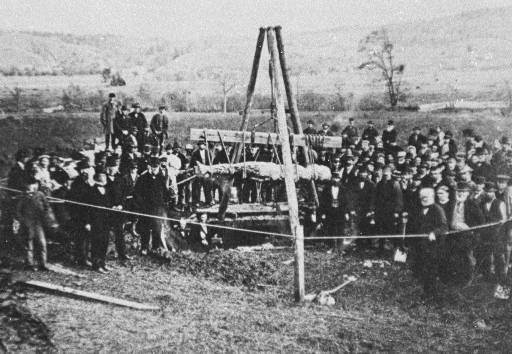
In fact, something about this whole story got me thinking about the Cardiff Giant.  Not so much as a criticism of Bell’s idea that a Christian might ‘live without God,’ which is mostly because it appears that his reasoning for doing so seems more like an attempt at testing a hypothesis which, if we hold to the predominant definitions of Modern Atheism, such as those promoted by Buckley (1990) or Hyman (2009, 2010), sounds like the objective turn from ‘God’ as subject to ‘God’ as testable object.  Rather, it got me thinking about the ways in which his process might represent the larger transition from Theism to Atheism, and how that is equally representative of the ways in which we might use these sorts of transitions (or if nothing else the story of these transitions) in order to ‘define’ that which these things represent. This got me thinking about the Cardiff Giant not because it was a hoax perpetuated by an Atheist in order to make a fortune, but because of the way in which the public devoured the story, merely because they were told it was real. cardiff_tfm_page_web The product of George Hull’s imagination and entrepreneurial spirit, the Cardiff Giant was a fabulous hoax, carved from gypsum and buried for some time in a field only to be ‘discovered’ by some unexpecting well diggers in October of 1869.Cardiff_giant_exhumed_1869  Shortly after, Hull’s partner, William Newell, placed a tent around the giant and began charging admission.  Soon, people were lining up to see the Giant, regardless of the fact that it was almost immediately dubbed a hoax by scholars and scientists, such as Othniel March.

As the profits grew even higher, Hull sold his interest in the hoax to a ‘syndicate’ that put it on display in New York, drawing ever larger crowds, including the renowned showman, P.T. Barnum, who offered barnum$50,000 for the Giant, only to be turned down.  Never to be out done, he hired his own craftsmen to recreate it, which he then put on display, claiming that his was the ‘real’ Giant.

In regard to the crowds tricked into paying to see Barnum’s false fake Giant, Newell notorious commented, “There’s a sucker born every minute.”

Eventually, the whole thing came down to court hearings and law suits about whose Giant was the genuine article until Hull finally confessed to the hoax in December of 1869.  Barnum was exonerated from any plagiarism charges because, as it turned out, it wasn’t quite possible indict someone for forging a forgery.

So, how does this relate to Bell’s ‘year without God,’ aside from the somewhat obvious connection to the ways in which we might bicker over term assignment or the meaning of concepts between notions of ‘Atheism’ or ‘non-religion?’  Well, perhaps a truly critical assessment might argue that his ‘project’ was nothing more than an attempt at masking his scepticism and doubt into a larger consideration that would have gotten him air time on NPR or international news.  Likewise, we might even contend that his ‘project’ was nothing more than a hoax perpetuated to gain some sort of notoriety.  Why, after all, would we care about one pastor’s progression from Theist to Atheist? Which, I think, is why I connected these two stories.

Such a critical assessment might be useful, even healthy, for certain individuals, but I think it equally overlooks the fact that, like the story of the Giant, Bell’s progression demonstrates not only a public interest, but a discursive insight as well.  After all, if we were intent on understanding how beliefs become solidified, such as the way a hoax is marketed and devoured by a demanding audience, or in Bell’s case, how identity becomes constructed, is this not the ideal set of data with which to study?  That is, though it might look, through a certain lens, to be something designed or formed in such a way as to inspire criticism, is it not still something worth examining?  Or, is all of this once again a reminder that no matter how cautious or critical we are, there’s never really a sure way of knowing if something is a hoax (such as discourse observed), so that we must continually remind ourselves, that in the study of ‘others,’ and regardless of objectivity, we might be nothing but ‘suckers.’

For more on the Giant:

Mark Rose, “When Giants Roamed the Earth” (Archaeology, Vol. 58, No. 6, 2005).

Fran Rizer, “A Hoax of a Ghost Hoax” (Which also includes a re-print of Mark Twain’s short story about the Giant, A Ghost Story).

For an excellent discussion of Bell’s ‘Year without God,’ as well as an incredible blog in general:

Jason Hines, “Look Within” (HineSight, 4 January 2015).

The three sources on Modern Atheism:

Michael J. Buckley, At the Origins of Modern Atheism (New Haven: Yale University Press, 1990).

Gavin Hyman, “Atheism in Modern History’ in Michael Martin, ed. The Cambridge Companion to Atheism (Cambridge: Cambridge University Press, 2009).

Gavin Hyman, A Short History of Atheism (New York: I.B. Tauris, 2010).

Everything is Fiction: A Discussion on Narrative and Reflexivity

It’s January.  That’s perhaps not all that surprising.  It’s also early January.  Which means, for some of us, we have entered that liminal stage between Christmas break and beginning a new semester.  This time, for me at least, is usually filled with anxieties.  There’s something about having no ‘real’ responsibilities that generates an incessant need to ‘do something.’  This, coupled with the notion that at the start of the year one must equally resolve to achieve some sort of important something within the year to follow, means planning.

For the year to come I have planned a number of what I hope will be intriguing and fun posts: an interpretation of New Atheism viewed through a unique filter; a three-part theoretical look at how disappointment assists in our development of the meaning of religion, as well as alters our means of religious identification; a correlative look at zombies and secularisation; the links between Atheism and types of ‘fiction;’ judicial definitions of Atheism as discourse; a brief look at Ethnographic Criticism and how it re-interprets our notions of authenticity and accuracy in describing ‘others;’ as well as many others.

Yet, as can be expected, there will of course be additions here that pop up unexpectedly.  Such a thing occurred this week as I was putting together a post on Ryan Bell’s ‘year without God’ (which will be posted next week).  As I began writing that up I thought instead that this week, the first post of the year, would perhaps afford a better opportunity to not only look back on an experience I truly enjoyed from last year, but also provide the chance to get a bit more nuance about what Everything is Fiction is all about.  Which, of course, begins with a story.

Just prior to my moving to Edinburgh in September 2011, I flew out for a few days the previous April to meet my supervisor and get an idea about both the University and the city-at-large.  After our brief meeting, I was invited to sit in on the final presentations of the bi-annual New College Post-Graduate Conference, which I gladly accepted.  When we arrived at Martin Hall, the last speaker had already begun, so we snuck in quietly and sat in the back.  This was my first experience listening to Christopher Cotter as he discussed his paper on New Atheism.  Later, as a few of us adjourned to The Wash, one of the local drinking establishments we have frequented religiously over the last few years (and for many years prior to my arrival), I made the acquaintance of David Robertson, a friend and colleague of Chris.’  They each have their own blogs, which can be accessed here: Chris and David.  As well, these two have successfully and graciously given us The Religious Studies Project, a one-stop shop for all things pertinent to the method and theory in the study of religion.  Each week, the RSP posts a podcast recording of an interview conducted with an academic who discusses his or her research in the study of religion.  It is, for me at least, an ideal place to access the discourse on the study of religion.

On occasion I have had the great privilege to participate in a number of these recordings, particularly roundtable sessions where a group of us discuss issues in the field of religious studies, usually whilst drinking.  One of these recent experiences, though the drinking took place after, rather than during, was held at the University of Chester after Chris and David gave a workshop on the ‘Digital Humanities,’ and David conducted an interview with Dr. Alana Vincent.  The roundtable was chaired by Chris, and included Dr Wendy DossettProf. Elaine Graham, Dr Dawn Llewellyn, and Dr Alana Vincent.  The theme was on narrative and reflexivity in the study of religion, and Chris and David felt that perhaps I might have something to contribute, given my interests in the use of fiction in the study and teaching of religion, as well as my criticisms on where we might draw the line between authenticity and authority in our use of particular textual sources.  For this I was, and am, quite thankful.

“>

I found the discussion not only exciting, engaging, and fun, but cathartic.  It was incredibly refreshing to have the opportunity to discuss, out loud, the topics, themes, and points I’d been thinking and writing about ever since I sat down to write my Thesis.  Not only that, but the other individuals involved each provided some excellent feedback and points to consider.  In fact, this roundtable could not have come at a more fortuitous time.  I had just finished the full draft of the thesis, and was taking a few days off before conducting the initial round of edits.  So not only was I already obsessively thinking about these topics, I was likewise in the mindset perhaps best suited for feedback.

In our discussion, my catchy catch-phrase ‘Everything is Fiction’ comes up quite frequently, which I was of course quite happy about.  As well, I think the way we discuss some of the ways this phrase might be interpreted do a bit more justice than I might do here (which is also a forthcoming post).  So, please do listen (or rather, watch) and enjoy.

To conclude this sort of New Years’ tangential look back, I am reminded again about timing.  In fact, when I really think about it, the timing of this roundtable was somewhat like my first meeting Chris and David, designed in such a way as if like the plot of some larger story.  Which, I suppose, provides even more evidence to the idea that everything is, indeed, fiction.

Parting is Such Sweet Sorrow

Recently, the whole country of Egypt (according to news headlines) banned Ridley Scott’s new film, Exodus: Gods and Kings.

Aside from the flagrant and frustrating use of a post-colon reminder that the story itself involves some sort of ‘vs.’ between ‘Gods’ and ‘Kings,’ the film itself looks like nothing more than another live-action retelling of a Biblical account.  Definitely not something worth banning.  In fact, when we watched it the other day, in a rather empty cinema here in Edinburgh, it served its purpose well, both as an entertaining and rather well-acted film that not only kept me busy for a few hours, but also gave me a reason to regale my viewing partner with my vast knowledge about the original story.  It’s little victories like this, little boosts of the academic ego, that really make life worth living.

So for me, the film was rather innocuous.  A fun retelling by a director (who, in the world of Hollywood, seems to get both credit and blame for an undertaking that involves hundreds of people working side by side for years with the singular goal of producing a finished product) whose previous films I’ve enjoyed regardless of their critical successes/failures (for example, take a look at A Good Year; critically disliked, but I’d argue thoroughly enjoying).  Yes, God is a snarky and bratty little English boy who seems frustrated to the point of tantrum.  Yes, most (though not all) of the actors speak with some sort of English/Australian accent hybrid (it’s a sand and sandals film, after all).  Yes, John Turturro (the Jesus himself) plays Seti I, father of Ramses II, pharaoh of Egypt.  Even Sigourney Weaver shows up for a few minutes, playing Tuya, Ramses’ vindictive and angry mother, before vanishing somewhere into the tapestry of the glorious set-pieces.  Yes, the majority of the actors are caucasian, as if to remind (as Ridley Scott sort of did) the viewers that for a blockbuster film to be successful, one needs blockbuster actors, who happen to be white (for example, look a Yul Brynner in The Ten Commandments, or The King and I, or Kings of the Sun, or just about anything else he was cast in).  Yes, the plagues are rationalised by Ewen Bremner’s ‘Expert’ as the result of a natural phenomenon begun by hungry and destructive crocodiles; and the parting of the red sea occurs after what we might presume is a meteorite creating a tsunami, that then retracts the water far enough to allow the Israelites safe passage across.  Is all of this reason enough to ban the film?  Perhaps for some, but then again my perception of the events depicted within does not carry the same sort of meaning it does for others.

My greatest curiosity, then, about this style of criticism has to do with why individuals seem to take blockbuster films such as this so seriously, as if Scott’s Exodus is somehow supplanting the one in the Bible.  We heard a bit of this a while back with Darren Aronofsky’s Noah which, aside from depicting a hoard of fallen angels as giant rock creatures that assist Noah and his family in building the Ark, also did (what I think) is an incredible job of merging the Biblical account of creation with images of the grandeur of evolution.

Yet, where I would draw the line between Noah and Exodus, aside from the artistic views of those involved in either, is the statement made by Russell Crowe’s Noah at the start of the above clip: “I’m going to tell you a story.”  Aronosfky knows that the Noah story is nothing more than that, and admits it.  Yet, he also likewise tells us that the evolutionary progress from big bang to homo sapiens is nothing more than a story as well.

When we consider this alongside Scott’s Exodus, we might come to similar conclusions: these are stories, both film and Biblical myth in equal measure, so that when they are retold like this, when they part ways from the original, perhaps the anxiety or disappointment felt by certain individuals is the worry that an inaccurate or ‘creative’ retelling betrays the original’s fallibility.  That is, if Ridley Scott can re-write the story so easily, then is the original nothing more than a template, a plastic and bendable thing able to be re-created, and thus void of what we might perceive as some sort of ‘sacred’ something?  Again, I would say yes and no.  After all, it all depends on the individuals involved and the discourse being used and/or amended.  Case in point: when the critically disliked and epic-looking Troy came out a few years back, with its predominant white cast and highly adapted re-telling of the Trojan war (which ‘historically’ took place around the same time as the Exodus out of Egypt), the film wasn’t banned for its inaccuracies or insults to history.  It was merely considered a bad adaptation of a myth.


Shrinkage

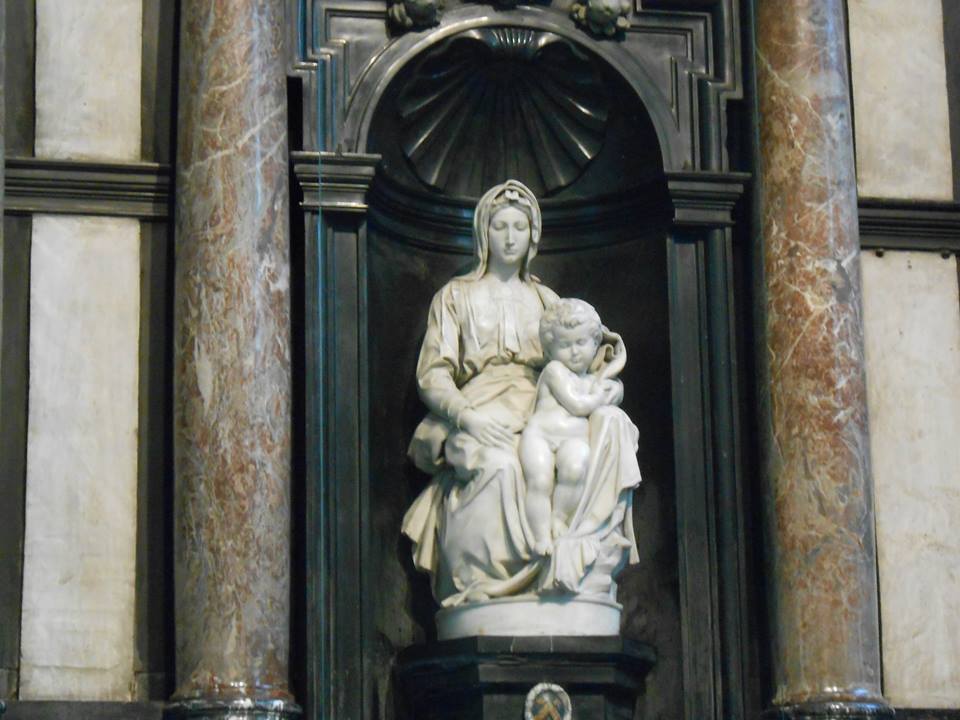
Within the altarpiece of the Church of Our Lady in Bruges, Belgium there is a renowned sculpture of the Madonna and Child by Michelangelo.  For two Euros, you may see it for yourself.  One rather remarkable part of this experience is just how cold it is within this marble space, cold enough that you can see your breath on the air, and for the guard stations to be equipped with heat lamps. Yet, this was not my immediate line of thinking.  Nor was it the beauty of the church or Michelangelo’s marble.  In fact, my bizarre train of thought—which I later divided into three interwoven sections—was as follows:

  1. It’s rather cold in here.
  2. That Baby Jesus is naked, that must be unpleasant.
  3. I think that Baby Jesus is uncircumcised, that’s odd.

This was immediately followed by a number of quasi-academic inquiries:

  • Should he, as a Jewish boy beyond eight days old, be snipped?
  • As well, why did this seem familiar to me?

madonna

When I voiced these sudden and reactionary thoughts out loud, my traveling companion was not altogether impressed by my criticism. She did, however, oblige enough to take a picture.

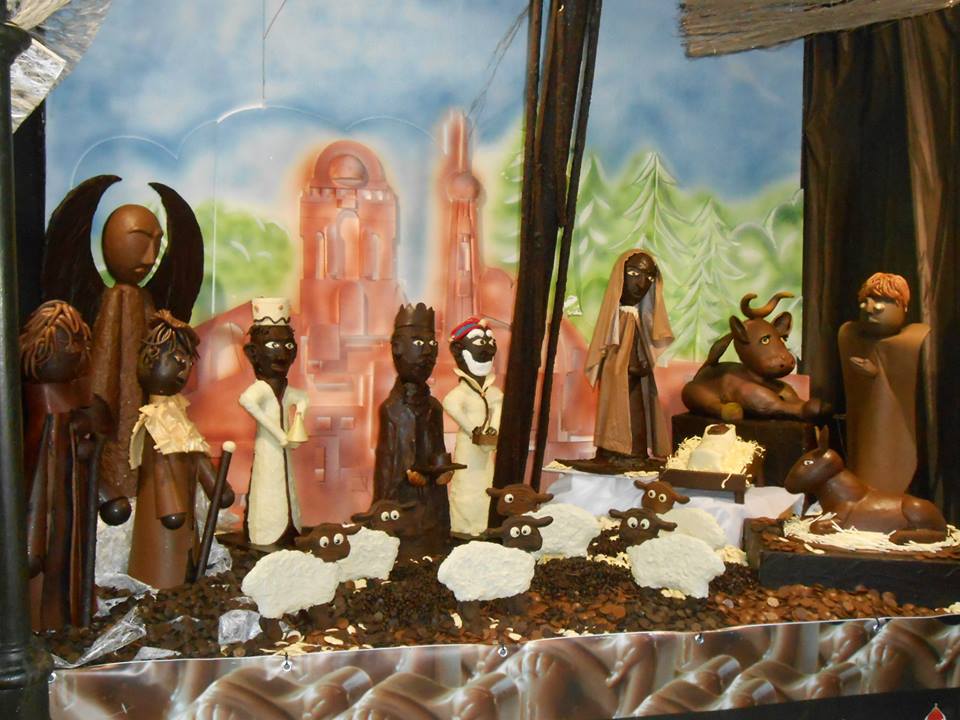
Later, as we were admiring the chocolate nativity in Burg Square,choco nativity just next to the Basilica of the Holy Blood where, twice daily, you can view a reliquary that holds the blood of Christ collected by Joseph of Arimathea at Christ’s crucifixion, it suddenly dawned on me where I might have made the connection between the poor, cold, and uncircumcised Baby Jesus and previous penile confusion.

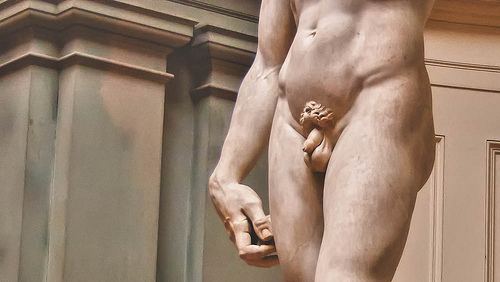
It all comes back to Michelangelo’s David.  This massive statue of the soon-to-be King of Israel, housed at the end of a long corridor in the Accademia di Belle Arti di Firenze, is renowned for its detailed depiction of the young shepherd as he prepares to take on Goliath.  For centuries, students and artists have studied Michelangelo’s ability to capture in chiseled stone the contours and fluid movement of muscle and tissue.

david pen

Yet, just like his Baby Jesus in Bruges, there is the obvious—more so, in fact, by mere size—foreskin.  Why is David, the Messiah, the Anointed One, uncircumcised?  Is this not a horrific mistake, an overlooked bit of anatomical inaccuracy?  Does this not, then, cause us to question the validity of Michelangelo’s depiction as nothing more than an incorrect alteration of Biblical ‘fact?’  Perhaps yes and no.

In fact, it seems less a specific amendment to the Biblical depiction of David, and perhaps more a product of Michelangelo’s environment.  The model, after all, was a Florentine youth, which accounts for the haircut and features.  As well, the reigning Catholicism of Michelangelo’s day was less concerned with the rites of circumcision, than of what the story tells us about Christ’s lineage.  For further details, one might peruse some of literature on this subject:

For this post, the point that I’d like to make once more deals with interpretation and ‘fact.’  Clearly, Michelangelo’s depictions of Jewish men are incorrect in that he has failed to represent them as they originally were.  Rather, he has given them his own ‘spin.’  Thus, his interpretations have ‘re-written’ historical details.  That is, if we take these depictions as representative of actual people in actual places at actual times, they are giving us the wrong information which, over time, might shift into being the ‘right’ information as we move further and further away from the context within which they were made.  This depicts a sort of ‘shrinkage,’ the dwindling away of intention coupled with the building up of inaccuracy.  It is in this way also where we, the interpreters of interpretation, begin to re-write history, even if by mistake.

If anything, David’s penis reminds me to proceed with caution, to view these sorts of fictions carefully, and to always be wary of where in these representations the line between fictions made-up and fictions made-from might be blurred.

That, and Happy Christmas.

Rumsfeldian Atheism

A few years back a friend asked if I wanted to be a part of a panel he was organizing for the Sociology of Religion Study Group (SOCREL) Conference held at the University of Chester. At the time, I had never attended an academic conference, and was keen on developing my CV, so my emphatic and immediate agreement to participate somewhat overshadowed the fact that I was a bit out of my purview. As I would later discover, the topic of the panel was to be on ‘Conspiracy Theories and Religion,’ a topic about which I knew very little beyond the few aspects that might have inadvertently popped up during my master’s research on New Religious Movements. Therefore, and in an effort to quickly cobble together some sort of correlative connection between Atheism and Conspiracy Theories, I threw together the following theoretical approach. In the years since, I’ve mostly forgotten about this theory, until I was reminded by a recent Facebook discussion pertaining to Pascal’s Wager.

As a reminder, and which will become important shortly, this ‘wager’ is one of many that make up the mathematician Blaise Pascal’s pragmatic approach to the existence of God. To summarize, it can be divided into four conclusions that lead to either infinite or finite results:

  • If an individual believes that God exists, and God does exist, that person achieves an infinite result: Heaven.
  • If an individual does not believe that God exists, and God does exist, that person achieves an infinite result: Hell
  • If an individual believes that God exists, and God does not exist, that person achieves a finite result: neither reward nor punishment.
  • If an individual does not believe that God exists, and God does not exist, that person achieves a finite result: neither reward nor punishment.[1]

In conclusion, Pascal ‘wagered’ that a life lived in the belief that God existed, whether or not He actually did, would lead to both a life lived in happiness on earth—without persecution, etc.—as well as a life lived in heaven. If it turned out that God did not exist, then the individual who didn’t believe so, but still lived as if He did, would experience no real loss. On the other hand, were God to exist, the individual who did not believe so, and lived as such, would be privy to unhappiness on Earth, as well as in Hell. This led to the argument that the former outweighed the latter in terms of a pragmatic and happy life.

The link between this sort of thinking and the ‘Rumsfeldian Atheism’ I will define below can be made via similar logical conclusions. However, how this sort of logic might also assist us in making sense of how we might define Atheism as exhibiting differing types of ‘Atheisms,’ is a bit more difficult.

A little background, then, in two parts.

First: Rumsfeld.

As the United States Secretary of Defense under George W. Bush, Rumsfeld had the difficult job of justifying a ground incursion on Iraqi soil. This was a particular issue because the reasons he had stated before—evidence of weapons of mass destruction in Iraq—were without evidential proof, and were thus unverified. Therefore, to further justify what would come to be known as the ‘Bush Doctrine,’ Rumsfeld made the argument that the lack of evidence for something did not equate that something as not existing. In other words: an absence of evidence was not the evidence of absence. This argument, as we soon discovered, reasoned the utility of a pre-emptive strike, an incursion made to rout out threats before they could be actualized. His argument, though quite logorrhean, is as follows:

Now what is the message there? The message is that there are known ‘knowns.’ There are things we know that we know. There are known unknowns. That is to say there are things that we now know we don’t know. But there are also unknown unknowns. There are things we don’t know we don’t know. So when we do the best we can and we pull all this information together, and we then say well that’s basically what we see as the situation, that is really only the known knowns and the known unknowns. And each year, we discover a few more of those unknown unknowns.

There’s another way to phrase that and that is that the absence of evidence is not evidence of absence. It is basically saying the same thing in a different way. Simply because you do not have evidence that something exists does not mean that you have evidence that it doesn’t exist. And yet almost always, when we make our threat assessments, when we look at the world, we end up basing it on the first two pieces of that puzzle, rather than all three.[2]

Here’s a short clip of his statement (the full version is difficult to find, and most clips have been edited or amended for humorous effect)

His logic here is pretty straight-forward, which I have amended as such:

  • Known Knowns: Things that we know exist. (Chemical and Biological Weapons manufacturing)
  • Known Unknowns: Things we know we don’t know. (The development of Chemical and Biological Weapons for the purpose of selling to American enemies, such as terrorist organizations)
  • Unknown Unknowns: Thing we don’t know we don’t know. (Are there Weapons Manufacturing we don’t know about just yet—are there threats we may not have perceived yet?)

The first category is justified by evidence.[3] We know these things are true. For instance, we know Iraq used Chemical Weapons (mustard/nerve agents) against the Iranians and Kurds between 1983 and 1988, as well as tested Biological Weapons (anthrax, aflatoxin, botulinum) that were to be destroyed between 1988 and 1991.

weapons testing

Evidence of Weapons Tested

Likewise, Iraq also continuously tried to establish un-sanctioned nuclear weapons facilities, as well as enhanced their soviet scud missiles and launching towers for longer-range attacks.

nuclear

Map of Nuclear Facilities

The second category is a direct result of the things we know from the first. For instance, knowing that Iraq had used similar weaponry, as well as had built manufacturing plants for nuclear and biological weaponry, these sorts of later images justified the fact that there may be things we don’t know: known unknowns.

chemical

Chemical Manufacturing

biological

Biological Manufacturing

Now, given this information, and by accepting there might be things we know we don’t know, we are inevitably led to conclude that perhaps there are things we don’t know we don’t know, which might lead to imminent and deadly threats. It is better, then, and because of this existing evidence, to live one’s life believing that there are things we might not know exist, and shape our perceptions into a pre-emptive preparedness.  This, in essence, is not unlike a Pascalian notion.  We brings us back to Atheism

Second: Atheism

For those un-familiar with my work on Atheism I am quite the advocate for dispensing with ‘defining’ the term, and the promotion of a more discursive analysis, what I quite precariously refer to as an ‘ethnographic approach.’ By this, I mean I would rather allow the individual Atheist define him or herself, rather than have that individual be defined by an external observer. One of the leading reasons for this defense is because of the way our own discourse on studying Atheism has seemed to lean more toward the latter.

While this discussion might extend beyond the limits of this present forum, how we came to this point can be briefly drawn out via two distinct categories: historical and theoretical. That is, if we take the discourse on defining the term ‘Atheism’ and treat it like a ‘field of discourse,’ we get a better idea about how the scholars who have done this defining over the last century have followed along a particular progression. In fact, the locus of this turn from defining Atheism via the way individuals have either historically been defined by others, or defined themselves, and theoretically stipulating what the term might mean in a ‘general’ capacity, is found in the way scholars have tried to cope with the differentiation between ‘ancient’ and ‘modern’ Atheisms. This has proven most troubling when the meaning of the former—a political term of censure or imputation given to an individual whose ideas or actions seem threatening to the status quo—and the meaning of the latter—a theological based and ‘parasitic’ conclusion made via re-emergent rational-naturalism that shifts the concept of ‘God’ from omniscient object to subject of inquiry that is then found evidentially false—is combined into a categorically mistaken conglomerate.

Out of this emerges a formulaic theoretical stipulation, what I have determined as the ‘positive vs. negative’ paradigm. For the last few decades just about every scholar who has written about Atheism has adopted this formula, determining an Atheist as someone who either positively asserts themselves as such, or someone who is an Atheist either by their ‘non-theistic’ beliefs—a rather normative and Western-centric idea—or through their ignorance or lack of knowledge about the existence of ‘God. In this way, Atheism has become a term that denotes a philosophical generality, so that it might be used to define any sort of denial, rejection, skepticism, or doubt. This is also why we find people defining ‘Atheism’ as a rejection of any and all sorts of religious or supernatural thinking, or the notoriously troubling notion of ‘Atheist religions’ defined by their innate differentiation from the three Abrahamic religions of Judaism, Christianity, and Islam. As a scholarly ideology, it has been standardized, which is evidenced by its use in Martin’s (2007) Cambridge Companion to Atheism and Bullivant and Ruse’s (2013) Oxford Handbook of Atheism. Even Wikipedia has adopted it.[4]

Though I should also note that my intention here is not to argue that this paradigm is wholly ‘incorrect.’ Rather, I have found that it’s formation, promotion, and advancement provides an intriguing insight into how theoretical thinking alters how difficult to determine concepts like Atheism or religion come to embody the meanings they have. For the former, this is a direct result of a generalization, a pragmatic attempt at making sense of a term that we ourselves have convoluted with our own theorizing. In fact, prior to the advent of this paradigm, Atheism was always defined via historical examples, using individuals as sources. It was not until the 1970s, and Anthony Flew’s Presumption of Atheism, that we began to see the term as encompassing an explicit or implicit nature. Which, really, makes its usage seem all the more precarious as Flew’s initial treatment—as we see repeated by Eller’s (2004) Natural Atheism and Baggini’s (2003) A Very Short Introduction—was made in order to argue that Atheism was mankind’s default position, as all people are born ‘negative Atheists’ because they are simply ‘without’ the belief that God exists.

While this discussion is one I tend to repeat with vigour, and though more of it will undoubtedly continue throughout this blog, this intro will have to suffice for now.

Rumsfeldian Atheism           

If we adopt Rumsfeld’s Pascalian logic from above, the positive vs. negative paradigm takes on a whole new meaning. In fact, we might even say it adopts a quasi-conspiratorial logic. If nothing else, it helps us make a bit more sense of how we might find ourselves thinking that there are differing types of Atheism across a polarity between explicit and implicit.

Let us begin with the Known Knowns: Atheism and Theism. This represents a dependent binary, the Theist and the Atheist equally ‘knowing’ what they believe: God exists and God does not exist. This is where we find ‘positive Atheism.’

Then, let us look at the Known Unknowns: Agnosticism. Here, if we define the term as a methodology—like Huxley originally did in 1893—used to answer the question of the existence of the Theist’s God, the ‘agnostic’ would fall under the purview of the known unknown. This individual acknowledges the existence of the Theist’s belief in the existence of God, as well as the Atheist’s rejection of that belief, but is not willing to commit to either side. In other words, and based on the first category, they know something that they acknowledge they don’t know in the way the Theist or Atheist does.

Finally, we arrive at the Unknown Unknowns: Negative Atheism. Defined as either an implicit absence of belief—due to a complete ignorance—or an implicit or explicit ‘lack’ of belief—leaning predominately on the etymological alpha privative ‘A’ in Atheism—this individual does not know what they do not know. In other words, they do not know that they do not know what the Theist or the Atheist believes, and are thus not only without the knowledge of the belief that God exists, but are without the knowledge of that knowledge as well.

Conclusion

If this sounds somewhat inane and confusing, that’s the point. While Rumsfeld’s argument about the threats we might not know about seems somewhat justified given the context in which it was made, my use of his categories was, and is, a critical one. It was adopted to point out the convolution we inflict upon ourselves in our attempts at theorizing around an issue, such as how to define a term that seems more and more confusing the more and more we try to define it. Scholars of religion know this all too well, as defining that term has generated the essential basis upon which we have built our ‘theories of religion.’

Yet, my use of it has meant more than just that. It’s also meant to point out that when we are examining or analyzing something that seems uncertain or confusing, the worst thing we can do is try to over-theorize about it. Rumsfeld, as well as the Bush administration, both learned this the hard way—some might say—and I think the academic study of Atheism is heading directly down that path. Rather than take a step back and try to understand the concept with which we are dealing, we seem overly destined to mark ourselves as presenting something unique or different. That is, rather than looking back at how this term has been defined by those who came before, and thus discover the manner with which we have progressively ended up with these sorts of abstractions, we seem happily set on making the discourse all that more excessive and incoherent—logorrhean—by adding to it with precarious and inane concepts like ‘ir-religon’ or ‘non-religion.’

In the end, I think we can learn a lot from Rumsfeld and his logic. If we just took the time to acknowledge that the discourse in which we are both analyzing and contributing to is merely a construct built upon a particular foundation, the less we might find ourselves sounding like someone trying to justify a judgment that we’ve already made.

[1] See Blaise Pascal, Pensées (New York: E. P. DUTTON & CO., INC., 1958), available online: http://www.gutenberg.org/files/18269/18269-h/18269-h.htm

[2] http://www.nato.int/docu/speech/2002/s020606g.htmfbg

[3] This evidence can be found at: https://www.cia.gov/library/reports/general-reports 1/iraq_wmd/Iraq_Oct_2002.htm#07

[4] http://en.wikipedia.org/wiki/Atheism#Definitions_and_distinctions

What do you call it when a gentile writes a post about Jewishness?

Last Spring I attended the 6th Israeli Conference for the Study of Contemporary Religion and Spirituality at Tel Aviv University, and presented my usual paper on the definition of Atheism and the use of fiction as ethnography. While the conference itself proved a better experience than I had expected, it was not without anxiety. After all, what might an individual who studies Atheism expect when visiting one of the cradles of Western monotheism? Would I be welcomed? Shunned? Ostracized? Might I be perceived as a threat? An enemy? An infidel? In fact, when I reflect on the short time I spent there, both in Tel Aviv, and wandering the streets of the Old City in Jerusalem, I have repeatedly found myself remembering aspects of that trip in ways I’m sure aren’t completely accurate, as if these questions have somehow transformed into a construction I might use in order to justify certain stereotypes about that part of the world.

These thoughts came to mind recently as we wrapped up our course on the Ethical and Religious Debates in Contemporary Fiction, particularly with our final text, Howard Jacobson’s The Finkler Question.  Despite winning the Booker Prize in 2010, this has proven a difficult novel to teach with, partly because Jacobson’s use of humour and stereotyping have often fallen flat with many of our students.  To summarise, the text provides an outsider’s perspective of a world he will never truly be a member of, offering us an insight into how he perceives that world, while at the same time providing a means with which to interpret that world itself.

Focusing on three lead characters—Julian Treslove, Sam Finkler, and Libor Sevcik—Jacobson’s fiction alters our perception of this insider/outsider paradigm on a number of occasions.  Yet, this is not what I wish to isolate herein.  Rather, as I read this text for the second time, I found myself considering how humour itself not only seems ingrained in making sense of and/or interpreting ‘Jewishness,’ but also how simplistically it seems this humour might turn from stereotyping to offensive when it changes from insider to outsider.  For example, Treslove (the gentile to Finkler and Sevcik’s Judaism) openly refers to Jews as ‘Finklers,’ based on his idea that his life-long friend is the paragon of Jewishness.  So, throughout the text, his references carry a humorous and personal separation from the more malignant sounding sorts of phrases that might be deemed verbally violent.  For example, when he finds himself having an argument with Hephzibah, his ‘Jewess’ girlfriend about his incessant assumption that some horrible experience is just waiting for him to discover it, he describes her, and her humour, as thus:

That was what it was to be a Jewess.  Never mind the moist dark womanly mysteriousness.  A Jewess was a woman who made even punctuation funny.  He couldn’t work out how she had done it.  Was it hyperbole or was it understatement?  Was it self-mocekry or mockery of him?  He decided it was tone.  Finklers did tone.[1]

Yet, when he tries to emulate her, he fails.  He is unable to recreate her ease of tone, her ability to make his own punctuation funny: “it could have been that Finklers only permitted other Finklers to tell Finkler jokes.” Which brings me to the locus of this particular discussion.  Is there a subtle line between humour and offence, and is that line more easily blurred for certain individuals?  

For our tutorial I prepared three examples with which to approach this question.  The first comes from the comedic genius Mel Brooks.  In it he sings his way through the horrors of the inquisition, while at the same time making humorous light of both the plight of the Jews massacred during the auto-da-fé, as well as the Catholics who were responsible for these atrocities.

Next, we watched the following clip from the Seinfeld episode entitled ‘The Yada Yada,’ which originally aired on 24 April 1997.  In this episode, Jerry is offended by his dentist’s conversion to Judaism, not as a Jewish person, he assures, but as a comedian.  His dentist, he is certain, merely converted for the jokes.  As ever erudite with its philosophical undertones, the episode is an ideal example of the sort of line-blurring between insiders and outsiders presenting humorous and stereotyping interpretations of themselves and others.

The third comes from an episode of the sitcom Frasier.  In this clip, Frasier comes to learn that his girlfriend ‘Faye’ was under the assumption that he was Jewish.  This is problematic for Faye’s mother, who we learn would prefer her daughter dating a Jewish man.  As per the humour of the show, Fraser, his brother Niles, and father Martin each take up stereotypical ways of sounding or acting ‘Jewish’ in order to keep Mrs. Moskowitz happy.

Now, in each of these clips humour and stereotyping are used to describe a type of ‘Jewishness.’  Yet, with the latter, we find an interesting situation that is separate from the others.  Perhaps more akin to Treslove’s attempts in The Finkler Question, in the Frasier clip the humour is coming from gentiles pretending to be Jewish for humorous effect.  Is this offensive?  Anti-Semitic?

As data, these clips, as well as Jacobson’s novel, are peculiar sources.  Yet, I equally like to think that they serve as reminders that we all construct stereotypes and assumptions that contribute to our larger perceptions about what particular identities look like.  I know I was guilty of this in my time in Israel, but I also know that it is in stereotyping and interpretation where we begin to create our ethnographic perceptions.  Thus, I further wonder if our outsider perceptions are offensive in the sense that we are trying to tell Finkler jokes without the benefit of an inherent Finkler tone?

[1] Howard Jacobson, The Finkler Question (London: Bloomsbury, 2010).

Harry Potter and the Precarious Use of Fiction

This semester marks the second year that I have tutored on a course that focuses on the ‘Ethical and Religious Debates in Contemporary Fiction.’  The course itself is divided into three sections: Christianity (Greene’s The Power and the Glory and Robertson’s The Testament of Gideon Mack), Secularism and Science (Huxley’s Brave New World, Pullman’s Northern Lights, and Rowling’s Harry Potter and the Deathly Hallows), and Judaism (Potok’s My Name is Asher Lev and Jacobson’s The Finkler Question).  While I have my criticisms—what does Harry Potter have to do with either science or secularism?!—and though this year saw the tragic, yet pragmatic, removal of McEwan’s Enduring Love, we have had some success in both bringing in a good number of students and keeping them engaged with the topics.  As well, while I also find myself asking a number of questions pertaining to the implicit notion that reading fiction offers us some sort of outlet different or better than merely examining how individuals shape their religious identities in the ‘real-world’ (and how that differs from a ‘fictional world’), this is not the present forum for such discussion.

Rather, one particular moment stands out that I feel needs a bit more nuancing.  During the tutorial on Harry Potter and the Deathly Hallows, the student whose responsibility it was to present and lead the discussion spent a good amount of time discussing the ‘reaction’ of certain people to the themes found within Rowling’s seven novels.  Built on the lecture given earlier in the week that also presented a few of these responses, this student very excitedly passed out copies of a ‘fan-fiction’ recently published online by the title “Hogwarts School of Prayer and Miracles,” by a Grace Ann Parsons under the name ‘aproudhousewife.’ (https://m.fanfiction.net/s/10644439/1/Hogwarts-School-of-Prayer-and-Miracles)  

Since throughout this course we have discussed the uses of fiction in making sense of or examining identity constructions that are attached to particular cultural concepts (like Christianity, Atheism, and Judaism), this student was quite excited to use this particular re-telling as a cultural source for a certain type of fundamentalist or evangelical Christianity.  That is, just as we can read Harry Potter to try and make sense of Rowling’s intentions (is Harry a cultural Christian, for example) this student felt we could equally use this re-telling to make sense of or examine how an individual’s re-interpretation might equally provide us with an insight on the cultural significance inherent in such a re-write.

A little background might help.

‘Hogwarts School of Prayer and Miracles’ is a fourteen Chapter fiction that adopts and re-imagines the storyline of the Harry Potter novels in order to make the ever-popular series accessible to a readership that might find the ‘witchcraft’ within the original offensive or dangerous. Or, as the author states at the beginning:

Hello, friends! My name is Grace Ann. I’m new to this whole fanfiction thing; but recently, I’ve encountered a problem that I believe this is the solution to. My little ones have been asking to read the Harry Potter books; and of course I’m happy for them to be reading; but I don’t want them turning into witches! So I thought….. why not make some slight changes so these books are family friendly? And then I thought, why not share this with all the other mommies who are facing the same problem? So-Ta da! Here it is! I am SO excited to share this with all of you!

Insights like this appear at the start of each Chapter, so that as we read along we’re provided with snippets of authorial intent.  In many ways mimetic of Geertz’s (1989) notion of ‘signature,’ these authorial insertions not only remind us that the fiction itself is manufactured with a purpose, but also that it exists as a representation of that purpose in textual form.  Likewise, we also find a number of inter-textual influences, provided by Biblical citations.  These act as discursive anchors, linking the author’s intention to her textual construction by means of referential correlations. For example:

  1. “God is dead! Dawkins proved that. Would you like us to educate you on the Dawkins?” (Chapter 1)
  2. “Five years down the road, Harry might have been a fornicating, drug-addicted evolutionist!” (Chapter 2)
  3. “His voice had a distinctive southern twang to it that made Harry feel so safe and welcome. He knew in that moment that the Reverend was a man of God.” (Chapter 3)
  4. “It is the mark of a true, old-fashioned gentleman to respect the fact that every young woman is another man’s future wife. And we all know that it would be a dreadful, terrible sin to bring another man’s wife into intimacy.” (Chapter 4)
  5. “Harry followed Ronald with the obedience of one who does not have many friends in a new situation. Oh, what a difficult circumstance that can be—and how many believers have been led astray by those situations!” (Chapter 5)
  6. “‘Women shouldn’t not have careers because women are stupid!’ Harry shouted indignantly. ‘Women are not stupid at all! Women should not have careers because women are nurturing and loving and their gifts serve them best in the home!’” (Chapter 6)
  7. “Harry hmmed to himself. He knew that the Reverend meant well; but was it really doing members of the other hats much good to tell them that everything was the same when it wasn’t? Wouldn’t they all be happier if they knew to read the Bible and take it seriously?” (Chapter 7)
  8. “‘But what about the Constitution?’ Dean Thomas questioned articulately. ‘Doesn’t he care about the First Amendment?’” (Chapter 8)
  9. “After the prayer session; the little ones all went to their classes—there were regular math and English classes, of course—although they were of a higher caliber than one would find in a Public School—and then there were Bible Studies and Christian History.” (Chapter 9)
  10. “Dean Thomas nodded sagely and muttered to himself in disgust, ‘First they try to change the Pledge of Allegiance. Now they don’t want us to be Christians. Next they’ll be killing us all. It’s a bad time to be a true Christian in America.’” (Chapter 10)
  11. “Harry gritted his teeth. He had had enough of this! So-called feminists these days call everything sexist. A man respecting his woman and providing for her and giving her the children and home that she truly desires is called woman-hating! Such silliness can make us forget what real sexism looks like. The truth is—women are just as smart as men; and God made us as their equals; but equal does not mean the same; and when we treat men and women as being the same and tell women to go to work all day and forget about her true calling as a wife and mother; then that is the real woman-hating!” (Chapter 11)
  12. “ In that moment, the hat on Draco’s head changed into a red and yellow one with a lion on it; and the tears rolling down his face were not sad tears. They were happy tears. The crowd of onlookers burst into applause; but Harry did not notice all the cheering students and teachers. He was bathing in the love of the Lord.” (Chapter 12)
  13. “But before they could think too much about that, a car pulled into the parking lot. It did not look like the car a busy mommy or daddy would have. No, this was a small so-called eco-friendly car. Harry, Dean Thomas, and Hermione looked at it suspiciously. They did not know who would come of it, but they got the feeling it would not be someone good.” (Chapter 13)        

By deciphering the meaning within these passages in relation to the authorial intent and Biblical citations provided (Ephesians 5: 22-24; Acts 5:29; Exodus 20:4-6; Matthew 7:1; Matthew 2:16-17; John 15:19; Proverbs 16:18), we can make use of this text as a source with which to interpret a particular type of identity.  This process works in the same way as reading an ethnographic account about a particular individual, such as Crapanzano’s Tuhami or Dwyer’s Moroccan Dialogues, or like reading an auto-ethnographic account, such as Jackson’s Barawa or Ellis’ The Ethnographic I, wherein our perception of the cultural representation is made through a filter by means of the ethnographer’s position as an insider.  

This process equally dismisses the ‘falseness’ we might infer in the fact that this is a ‘fiction’ by translating the text itself into a discursive source, so that when the author has her characters argue the merits of gender subordination within a ‘proper Christian society’ by citing the Biblical passage, “Wives, submit yourselves to your own husbands as you do to the Lord,” and Debi Pearl’s Created To Be His Help Meet, the text itself becomes something more ethnographically useful.  This is, in fact, not all that different from reading something like Harry Potter in order to make sense of Rowling’s intentions, and how the text itself has been used by readers in and out of her own culture.    

This is also, in essence, how the student in our tutorial made use of ‘Hogwarts School of Prayer and Miracles.’  Having been transmuted from mere fan-fiction to cultural representation, we began reading it as a discursive example of the way in which a particular individual might construct and validate her identity, as well as how that construction might alter her perception of the world and thus dictate the manner with which she might externally construct the identities of her children.  This is also, interestingly, our purpose of the course in general, only writ small.

Likewise, it is an equally wonderful example of the precarious and dangerous method of using ‘fiction’ as a source for cultural insight.  Mostly because ‘Hogwarts School of Prayer and Miracles’ isn’t real.  By this, I don’t mean that it’s merely ‘made-up.’  All fictions, both true and false, are ‘made-up.’  This fiction is made-up in that it is a fiction of a fiction of a fiction.  To sound less confusing, it is an example of Poe’s Law, which is defined as such:

Similar to Murphy’s Law, Poe’s Law concerns internet debates, particularly regarding religion or politics.

‘Without a winking smiley or other blatant display of humor, it is impossible to create a parody of Fundamentalism that SOMEONE won’t mistake for the real thing.’

In other words, No matter how bizarre, outrageous, or just plain idiotic a parody of a Fundamentalist may seem, there will always be someone who cannot tell that it is a parody, having seen similar REAL ideas from real religious/political Fundamentalists. 

This text is an example of an individual creating an invented individual who has created a text in a manner pursuant to the way the first individual believes the second individual might think.  In other words: it is a satire.  Evidence of this can be found in the meta-fictional exchange between ‘Dumbledore’ and ‘Voldemort’ in the conclusion:

“Aren’t there better ways to spend your time than preaching to a bored idiot who makes fun of people in the internet?” Voldemort questioned hedonistically. “Your Lord seemed to be pretty concerned about helping the people around him. Is that not his work anymore?”

“How can we focus on helping people; when there are people like you trying to destroy us?” Dumbledore countered astutely. 

“I told you before, that Reddit account is a joke,” Voldemort whined pathetically; but the Reverend shook his head.

“I thought that might be so at first,” the Reverend commented fairly. “But it was just too realistic.”

“How is it realistic?” Voldemort inquired uniformedly. “It wasn’t even subtle! I waxed poetic about the sexiness of neckbeards and said that Christopher Hitchens has superpowers. It was supposed to be funny! How could you take it seriously?”

Dumbledore scoffed; and he replied faithfully, “Like it or not—your little ‘joke’ is what most atheists today are like.” 

“So my Reddit account solidified your conception of atheists as a bunch of anti-Christian bigots who are just angry at God?” Voldemort solicited stupidly; and then he sighed. “Okay, you know what, this has gone too far. I’m sure that most people can tell that I’m not being serious, but if I’m contributing to misinformation and stereotypes, I don’t feel comfortable continuing this.” 

Voldemort pulled an iPhone out of his pocket; and he began to type on it. After a few minutes, he showed the screen to Dumbledore. “See this? I just made a post: ‘I am a troll.’ It is the last post I will make on that account. Are you happy?”

Yet, even when we realise the ‘false’ origins of this re-write, I still find myself unable to outright dismiss it.  Which is how I made use of it for the tutorial.  After analysing the text and concluding that it provided for us in equal measure an insightful glimpse of a particular cultural perception, I revealed to the students its more satirical origin with the caveat that it is still useful.  Perhaps not necessarily as we might have originally intended, if nothing else ‘Hogwarts School of Prayer and Miracles’ provides for us an example of the precariousness in blurring the lines between texts that are ‘fictions’ and those that are not (such as auto-ethnography).  It reveals to us the difficulty, even danger, in inherently trusting textual accounts, whether ‘fictional’ or ‘ethnographic.’  Because, every text/account is infected with intention, and deciphering how that intention might alter the information provided within is a difficult task, especially with fiction.  After all, we might interpret aspects of Harry Potter different from how Rowling had intended, but that does not mean our interpretation is incorrect.  Nor, at the same time, does it mean her intention is incorrect either.  

Which, as a conclusive statement, I believe adds a bit more nuance to my notion of ‘everything is fiction.’  Textual analysis is quite complex, and fraught with possible misinterpretations.  Examining and interpreting texts such as ‘Hogwarts School of Prayer and Miracles’ reminds us of this, particularly because without knowing the actual origins, all we have left is interpretation.  Perhaps more than anything, then, I think this example reminds us of this sort of precariousness which, in regard to the larger notion of examining culture through words on the page, is never a bad thing to remember.   

J.K. Rowling, Harry Potter and the Deathly Hallows (London: Bloomsbury, 2007).

Grace Ann Parsons, “Hogwarts School of Prayer and Miracles,” Original Fan-Fiction: https://m.fanfiction.net/s/10644439/1/Hogwarts-School-of-Prayer-and-Miracles (accessed 25 November 2014).

Debi Pearl, Created to be His Help meet: Discover How God Can Make your Marriage Glorious (Pleasantville, TN: NGJ Ministries, 2004).

“Poe’s Law,’ Urban Dictionary Reference: http://www.urbandictionary.com/define.php?term=Poe’s%20Law (accessed 25 November 2014).

Clifford Geertz, Works and Lives: The Anthropologist as Author (Stanford: Stanford University Press, 1989).

Vincent Crampanzano, Tuhami: Portrait of a Moroccan (Chicago: The University of Chicago Press, 1980).

Kevin Dwyer, Moroccan Dialogues: Anthropology in Question (Baltimore: The Johns Hopkins University Press, 1982).

Michael Jackson, Barawa and the Ways the Birds Fly in the Sky (Washington, D.C.: The Smithsonian Institution Press, 1986).

Carolyn Ellis, The Ethnographic I: A Methodological Novel about Autoethnography (Walnut Creek: Alta Mira Press, 2004).

Everything is Fiction

To begin, ‘Everything is Fiction’ is not my idea.  Rather, it’s an idea that I have adopted for pragmatic reasons.  For the purposes of an introduction, the manner with which I have made—and will make—use of it in this capacity can be traced to an origin with Vaihinger’s (1935) Die Philosophie Des Als Ob, wherein ‘consciously false’ fictional explanations are seen as accepted within the absence of evidential phenomena:

I wanted to give a complete enumeration of all the methods in which we operate intentionally with consciously false ideas, or rather judgments.  I wanted to reveal the secret life of these extraordinary methods.  I wanted to give a complete theory, an anatomy and physiology so to speak, or rather a biology of ‘As if.’  For the method of fiction which is found in a greater or lesser degree in all the sciences can best be expressed by this complex conjunction ‘As if’.[1]

Though differentiated from an ‘hypothesis,’ which can be verified as either true or false, Vaihinger’s use of ‘as-if’ depicts a special kind of fiction, something unverifiable, but that appears to be ‘as-if’ it is.  As Fine (1993) deduces: “if we knowingly retain a false but useful hypothesis, we have a fiction.”[2]

This is close to my usage, but not exact.  In fact, I might borrow even further from Kliever (1979) and Miller (1997).  The former defines this sort of fiction as such:

Given the linguisticality and historicity of human existence, all reality claims are fabrications or constructions.  ‘Facts’ are symbolic constructions which have been established as reliable representations of a world that exists independently of all human imagination and intervention.  Fictions are not simply symbolic constructs which have yet to be verified.  They are not hypotheses whose truth remains in doubt for the present.  They are symbolic constructs which cannot be verified and hence cannot be true.[3]

The latter, who actually uses the term ‘everything is fiction,’ divides the notion into four parts:

‘Everything is fiction’ may mean at least four distinct things: (1) simply that all human knowledge includes constructs; (2) that all actual, or even all possible, such forms of knowledge are nothing but constructs or fictions, and that data, if any are admitted at all, are always just projections out from that fiction; (3) that our most fundamental categories of possible experience are such constructs, so that reality itself can be nothing but fiction; and (4) that scientific fictions are ultimately no different from literary fictions. Arguments for (4) tend to merge with those for (2) or (3).”[4]

Likewise, we can look at other individuals, such as Anderson (1983) or Cusack (2010), who use ‘fiction’ in the sense of ‘imagined communities'[5] or ‘invented religions.’[6]

For my intentions I will be stealing from each of these.  From this point forward, and in this context, ‘EVERYTHING IS FICTION’ means two things:

  1. Meaning, such as ‘reality claims,’ all derive from stories.  Stories are how we communicate.  They function on dialogue and interaction, and it is through interactions with others that we begin to understand ourselves.  Stories are how we shape our lives, make sense of disorientation, and re-orientate ourselves in the face of disappointment or triumph.  Religion, history, culture, science, and philosophy: all of these are products of stories.  However, because stories function on dialogue and communication, stories are also discourse.  Therefore, stories are neither true, nor false, neither fiction, nor fact.  They are just discourse, and can only be perceived and examined as such.
  2. As discourse, stories are constructions, so that the meaning or ‘truth’ sourced from within them is dependent upon discursive contextualization.  In this way, much like how Kliever or Miller depict all claims of reality or all human knowledge as ‘fabrications’ or ‘constructions,’ translated herein, ‘fictional construction’ does not mean something ‘made-up’ or ‘false.’  Rather, it means something ‘made-from’ or manufactured as well, what Geertz refers to as ‘faction,’ a precarious portmanteau that depicts even the most objective of ethnographic texts as “imaginative writing about real people in real places at real times.”[7]

As the title of my Doctoral Thesis, ‘Everything is Fiction’ is meant as a critique, in both meanings of the term.  It represents a direct and nuanced analysis of ‘fiction,’ treating texts clearly ‘made-up’ as if they offer cultural insight in equal measure to ethnographic ones.  By doing this, the phrase also denotes a criticism of the manner with which we willingly trust or authenticate these sorts of ‘objective’ and ‘true’ accounts, regardless of the fact that they too have been constructed by an author who, like his or her equal the novelist, has designed the text out of his or her imagination.  Textualized culture is still filtered, no matter how objective we are, and it is this notion that underscores my belief that ‘everything is fiction.’

Everything is based on a story, stories are based on discourse, and discourse is always constructed.

Just as I determine in the Thesis, and just as I’ve drawn-out here, the following Posts will be stories.  They will be both fiction and non-fiction, true and false, made-from and made-up.  They will be constructions based on perception and created via interpretation.  Just like the Thesis, they will be an attempt at perceiving discourse through a particular lens, through the precarious notion that equally considers: ‘if everything is fiction, than nothing is.’

[1] Hans Vaihinger, The Philosophy of ‘As If:’ A System
of the Theoretical, Practical and Religious Fictions of Mankind, C.K. Ogden, trans. Second Edition (London: KEGAN PAUL, TRENCH, TRUBNER &: CO., LTD., 1935), xli.

[2] Arthur Fine, “Fictionalism” (Midwest Studies in Philosophy, Vol. 18, 1993), 8.

[3] Lonnie D. Kliever, “Polysymbolism and Modern Religiosity” (The Journal of Religion, Vol. 59, No. 2, 1979), 189.

[4] Eric Miller, “Literary Fictions and As-If Fictions” (Philosophy & Rhetoric, Vol. 30, No. 4, 1997), 429.

[5] Benedict Anderson, Imagined Communities: Reflections on the Origin and Spread of Nationalism (London: Verso, 1983).

[6] Carol M. Cusack, Invented Religions: Imagination, Fiction, and Faith (Surrey: Ashgate, 2010).

[7] Clifford Geertz, Works and Lives: The Anthropologist as Author (Stanford: Stanford University Press, 1989), 141.